






If you're considering HubSpot and have come across StrateCo, or vice versa, you've probably already realized that something isn't quite right with a direct comparison. It's not like choosing between Coca-Cola and Pepsi.
It's more like choosing between a professional kitchen and a personal chef: both feed you, but they work in completely different ways.
This article is not intended to declare a winner. Its goal is to help you understand what each one does, where they overlap, and, above all, where they clearly diverge.
What is HubSpot
HubSpot is an all-in-one CRM platform founded in 2006 with a clear mission: centralize all marketing, sales, and customer service activities in a single environment.
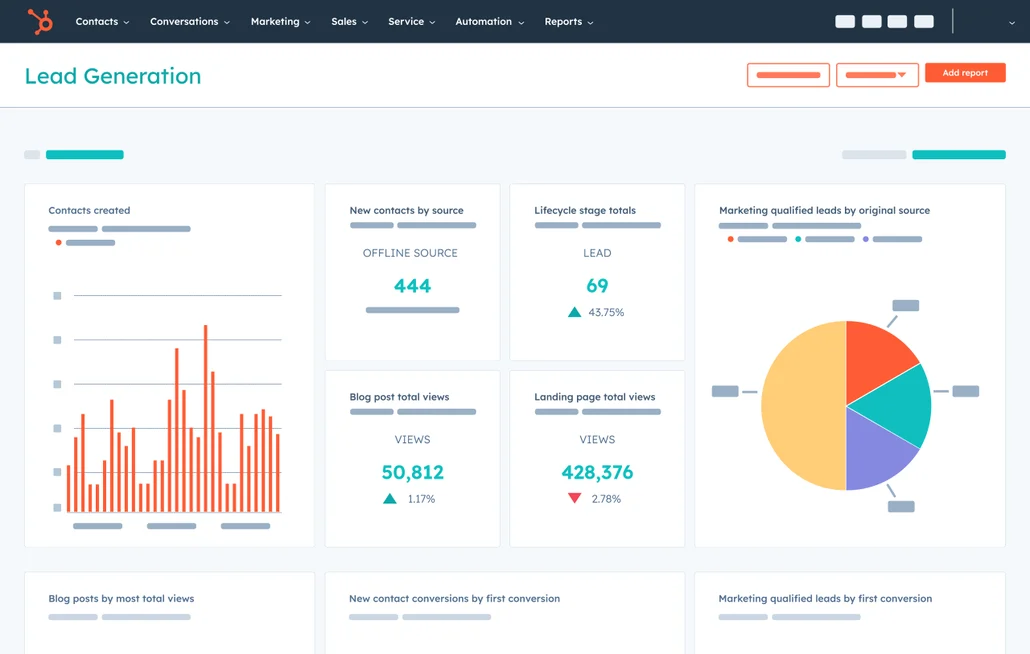
Over time, it has become one of the most widely used software globally for companies that want to manage contacts, automate emails, build landing pages, track the sales funnel, and analyze performance in a single dashboard. Its historical strength is integration: everything talks to everything, from the first ad click to the signing of the contract.
HubSpot is divided into modular "Hubs": Marketing Hub, Sales Hub, Service Hub, CMS Hub, Operations Hub. Each module is paid for separately (or in a bundle), and costs can rise rapidly as you add contacts and advanced features.
It is a tool designed for structured teams with defined processes who need a reliable system of record. The CRM is free in its basic version, but to truly leverage advanced automations and reports, you enter price ranges from a few hundred to a few thousand euros per month.
In essence: HubSpot is an infrastructure. You install it, configure it, populate it with data, and from there you manage the entire customer lifecycle.
What is StrateCo
StrateCo is an AI-powered marketing intelligence platform that works like a team of virtual specialists dedicated to your brand. It's not a CRM, it doesn't manage your contacts, and it doesn't automate emails to your leads.
What it does is different: it gives you access to six specialized agents, each with specific skills, who work conversationally. There's Enrico for SEO, Gary for copywriting (based on direct response marketing principles), Frida for social media, an agent for business strategy, one for advertising, and one for market research.
The point that distinguishes StrateCo from normal AI chatbots is access to real data. The agents don't operate in a vacuum: they use professional APIs like DataForSEO for SEO data, Apify for social scraping, World Bank, and OECD for market data.
Each project has its own customizable knowledge base, so agents understand your brand, your tone of voice, and your history.
The pricing model is pay-as-you-go (1 credit = €0.01), with a Pro plan supporting up to 50 projects. The entry point is free.
In essence: StrateCo is a team of AI consultants. You use it when you need analysis, content, strategy, and insights, not to manage your customer database.
Where they are similar
Despite structural differences, there are areas where the two tools cover similar ground.
Both support marketing teams with features related to content production, performance analysis, and campaign optimization.
HubSpot has its blog and landing page editor, integrated SEO tools, and campaign reports. StrateCo has Gary for copywriting and Enrico for SEO analysis with real data from DataForSEO.
Both are designed for those who want to stop using ten separate tools and find more consistency in their workflow. The difference is the level at which they operate: HubSpot unifies operational data, StrateCo unifies specialized expertise.
Both support multi-project or multi-client logic, useful for agencies and consultants who manage multiple brands in parallel.
Where they clearly diverge
This is where the comparison becomes more interesting.
HubSpot is a management system: it tracks who opened your email, who visited the landing page, who became a customer. It is a living database that grows with your company. Without someone to populate it, configure it, and maintain it, it remains an empty skeleton.
StrateCo manages nothing in this sense. It doesn't know how many leads you have, it doesn't track your sales pipelines, it doesn't send automatic emails. It produces output: analysis, texts, strategies, market insights. It is a creative and analytical input tool, not an operational output tool.
Another substantial difference concerns data access. HubSpot works with your internal data: what you yourself enter or import. StrateCo works with real external data: search trends, SERPs, competitors, institutional market data. These are two complementary types of intelligence, not substitutes.
On the cost front, HubSpot requires a significant financial commitment to unlock advanced features. StrateCo has a more flexible model, also suitable for freelancers and small businesses that cannot afford an enterprise suite.
Comparative table
Feature | HubSpot | StrateCo |
|---|---|---|
Tool type | CRM + marketing suite | Specialized AI team |
Contact management/CRM | ✅ Yes | ❌ No |
Email marketing automation | ✅ Yes | ❌ No |
AI Copywriting | Limited | ✅ Yes (Gary) |
SEO analysis with real data | Basic | ✅ Yes (DataForSEO) |
Business strategy | ❌ No | ✅ Yes (Jakob) |
Social media management | Limited | ✅ Yes (Frida) |
Market data (OECD, World Bank) | ❌ No | ✅ Yes |
Knowledge base per project | ❌ No | ✅ Yes |
Interface | Dashboard | Conversational (chat) |
Entry-level price | Free (basic CRM) | Free (PAYG) |
Advanced costs | Hundreds/thousands €/month | €0.01 per credit |
Who it's for | Structured teams, companies | Freelancers, teams, agencies |
Does it make sense to use them together?
Yes, this is probably the most honest answer.
If you already have HubSpot (or are considering it), StrateCo doesn't replace it and doesn't compete with it. It fills the gaps that HubSpot, by its nature, doesn't cover: SEO content production based on real data, competitor analysis, positioning strategy, copy for your campaigns.
HubSpot tells you what's happening in your funnel. StrateCo helps you understand what to do in your market and how to communicate it.
Many teams already use different tools for these two functions: a CRM on one side, separate tools for SEO, copy, and social on the other. StrateCo tries to consolidate the latter part into a single conversational environment, just as HubSpot has consolidated the former.
Which one to choose, then
It depends on where you are and what you need now.
If your main problem is managing contacts, automating nurturing, and tracking sales, HubSpot is the right tool. If, on the other hand, you need SEO analysis, quality content, market insights, and strategy, and you don't want to pay for five different tools, StrateCo is worth a try.
If you already have a solid operational structure and are looking to improve the quality of your marketing (content, positioning, research), the two tools complement each other well.
The choice is never between A and B. It's about what you need to solve today.