








Writing an SEO pillar article is one of those tasks every marketer knows they should do, but it invariably ends up at the bottom of the priority list.
The reason? Simple: it requires research, analysis, structure, optimization. And most importantly, time. Time that nobody ever seems to have enough of.
A well-done pillar article can rank for dozens of keywords, attract natural backlinks, and become the most visited content on your site for months. The problem has never been the "what," but the "how" to get there without blocking an entire day.
StrateCo has condensed this process into less than two minutes. And I'm not talking about shoddy content generated with ChatGPT and a prayer.
I'm talking about a REAL SEO pillar article, built on search intent analysis, real keyword research, semantic clustering, competitor study, and on-page optimization.
The kind of article that used to require an SEO specialist, a copywriter, and half a day's work.
Not by cutting corners, but by automating all those phases that previously required hours of manual work and three different tools open simultaneously.
Here I'll show you exactly how it works and why you should at least try it once.
What is a pillar article and why is it essential for SEO
A pillar article is a long, in-depth piece of content that covers a topic comprehensively. It doesn't just scratch the surface: it addresses every relevant sub-topic, answers the most searched questions, and becomes a reference point for anyone seeking information on that subject.
For Google, a pillar article is a strong signal of expertise. It tells the search engine: "This site knows the topic thoroughly; it can be a reliable resource."
Why it works so well in practice:
Covers multiple keywords with a single piece of content. A well-structured pillar article ranks for dozens of related searches, not just the main keyword. This multiplies organic visibility without multiplying effort.
Attracts natural links. When content is truly comprehensive and useful, other sites link to it as a resource. And backlinks remain the fuel for organic ranking.
Creates a topic cluster structure. The pillar becomes the center of an ecosystem of satellite content that links to each other, strengthening the thematic authority of the entire site.
Keeps the reader on the page. Rich content, well-organized and with clear headings, increases dwell time. And Google interprets this as a sign of quality.
The downside? Creating a serious pillar article usually requires several hours: keyword research, SERP analysis, competitor study, outline construction, writing, on-page optimization.
For many companies, freelancers, and agencies, it's an investment that ties up resources for an entire workday.
What is StrateCo
StrateCo is an AI marketing platform where you work side-by-side with a team of specialized agents. Not a generic chatbot you ask to "write an article" hoping for the best, but digital professionals, each with a specific role and dedicated tools.
There are those who deal with SEO, those with copywriting, those with advertising, those with social media, those with market analysis, those with business strategy. Each agent has specific skills, access to real data, and a different approach.
The agent we're interested in for pillar articles is Enrico. He is the platform's SEO specialist and has direct access to DataForSEO, one of the most reliable professional APIs in the industry. When Enrico analyzes a keyword, he doesn't guess: he retrieves real search volumes, keyword difficulty, SERP analysis, People Also Ask, autocomplete suggestions.
When you ask him to generate a pillar article, Enrico doesn't just "write a long text with some keywords in it." He activates a five-step process that integrates data research, competitive analysis, semantic clustering, and optimized content generation.
All automatically, all in less than two minutes.
If you're familiar with the frustration of spending half a day on a single article only to find it doesn't rank, what follows will interest you.
How to create your pillar article: a step-by-step guide
From your perspective, the process is linear. Behind the scenes, a lot happens. Let's look at both.
Start Enrico's Generate SEO Article task
Sign up for StrateCo for free: you immediately get 1,000 welcome credits, more than enough to generate your first pillar article.
Select Enrico, the SEO agent, and at the top of the chat, you'll find his popular tasks: these are pre-configured actions, each designed for a specific SEO activity. SERP analysis, keyword research, technical audit...
What interests us: Generate SEO Article.

Click on it and a form opens where you enter the main keyword you want to rank for.

You can also choose the tone of voice (professional, conversational, technical), the target audience, the length of the article, and a field for additional free instructions: for example, "include a paragraph on our proprietary method," or "use a more practical approach with real examples," or "do not mention competitor X." Anything you need to tailor the output to your specific needs.
Fill in, click generate. Enrico does the rest.
What happens behind the scenes
1. Real-time data collection
The system does in seconds what would take you an hour with Excel sheets and different tools.
In parallel, Enrico retrieves up to 100 related keywords with real volumes and difficulty, the top 20 Google results for that keyword, "People Also Ask" questions, and Autocomplete suggestions.
Then he groups everything into semantic clusters: groups of related keywords that identify the sub-topics to be covered in the article.
2. Competitor analysis
With the collected data, the system studies what is working on Google for your keyword. What type of content dominates the first page? What is the average length of ranked articles? Is there a featured snippet to conquer? And most importantly: what topics do competitors cover and which do they not?
This last point is the most valuable. Content gaps, i.e., topics that only a few results cover, are precisely your opportunities to differentiate yourself and offer something that Google's first page doesn't yet have.
3. Outline and article generation
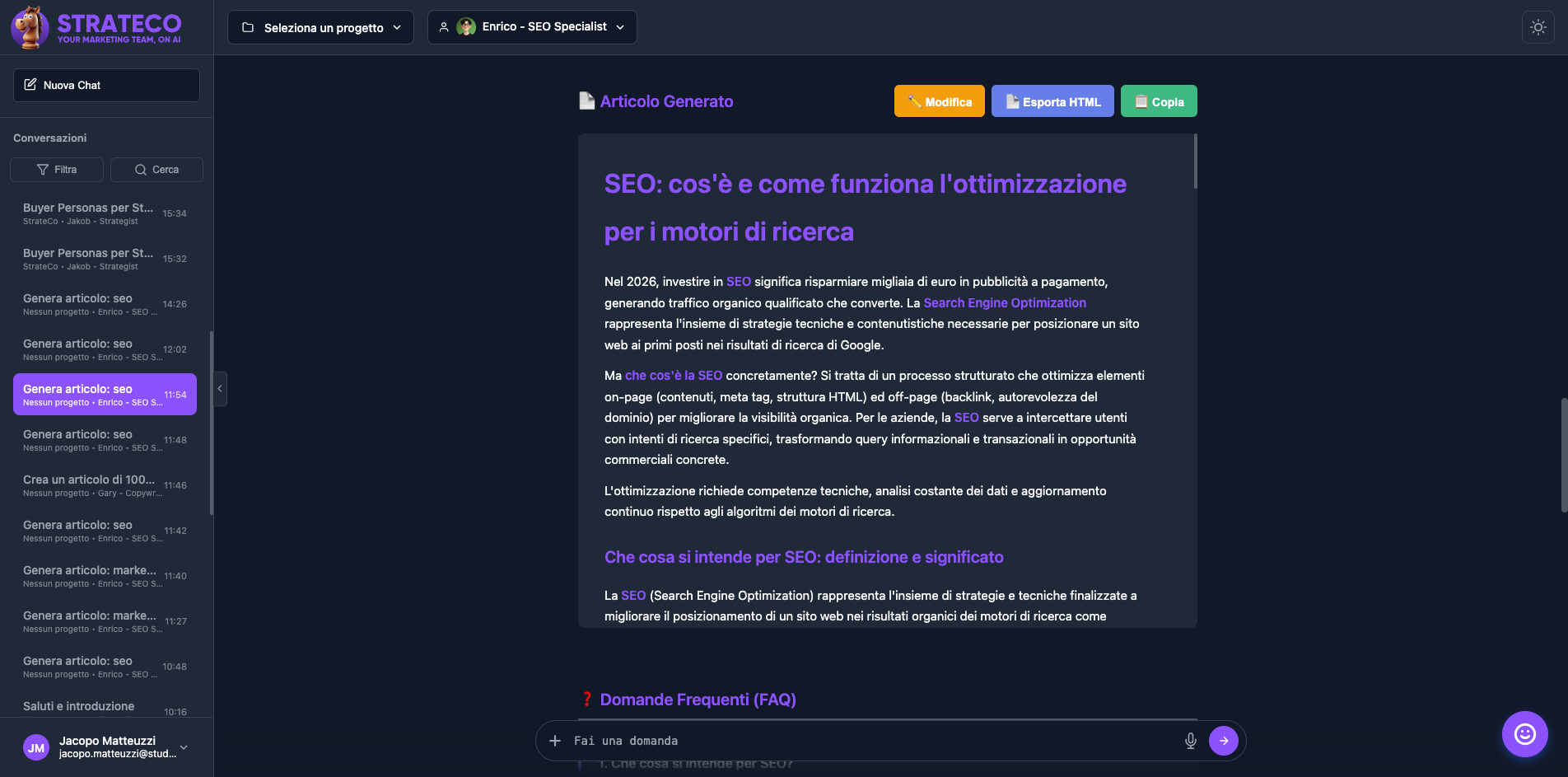
Based on all this data, Enrico first generates a complete structure: SEO-optimized title, meta description, H2 headings, and five FAQs based on the real questions people search for. Then he writes the article section by section, in semantic HTML ready for publication.
The keyword is placed where it really counts: in the title, in the first 100 words, in the headings, in the conclusion. The structure is designed to be scannable: clear headings, bulleted lists, strategic bolding, short paragraphs. And the FAQs are generated from real People Also Ask, not invented.
4. SEO score and review
The generated article receives an SEO score out of 100, a kind of self-assessment that the system performs on its own work: it checks that all on-page best practices have been met before delivering the result to you. Nine parameters: keyword in title, keyword density, heading structure, length, internal links, number of paragraphs, lists, keyword in the first 100 words, use of bold.
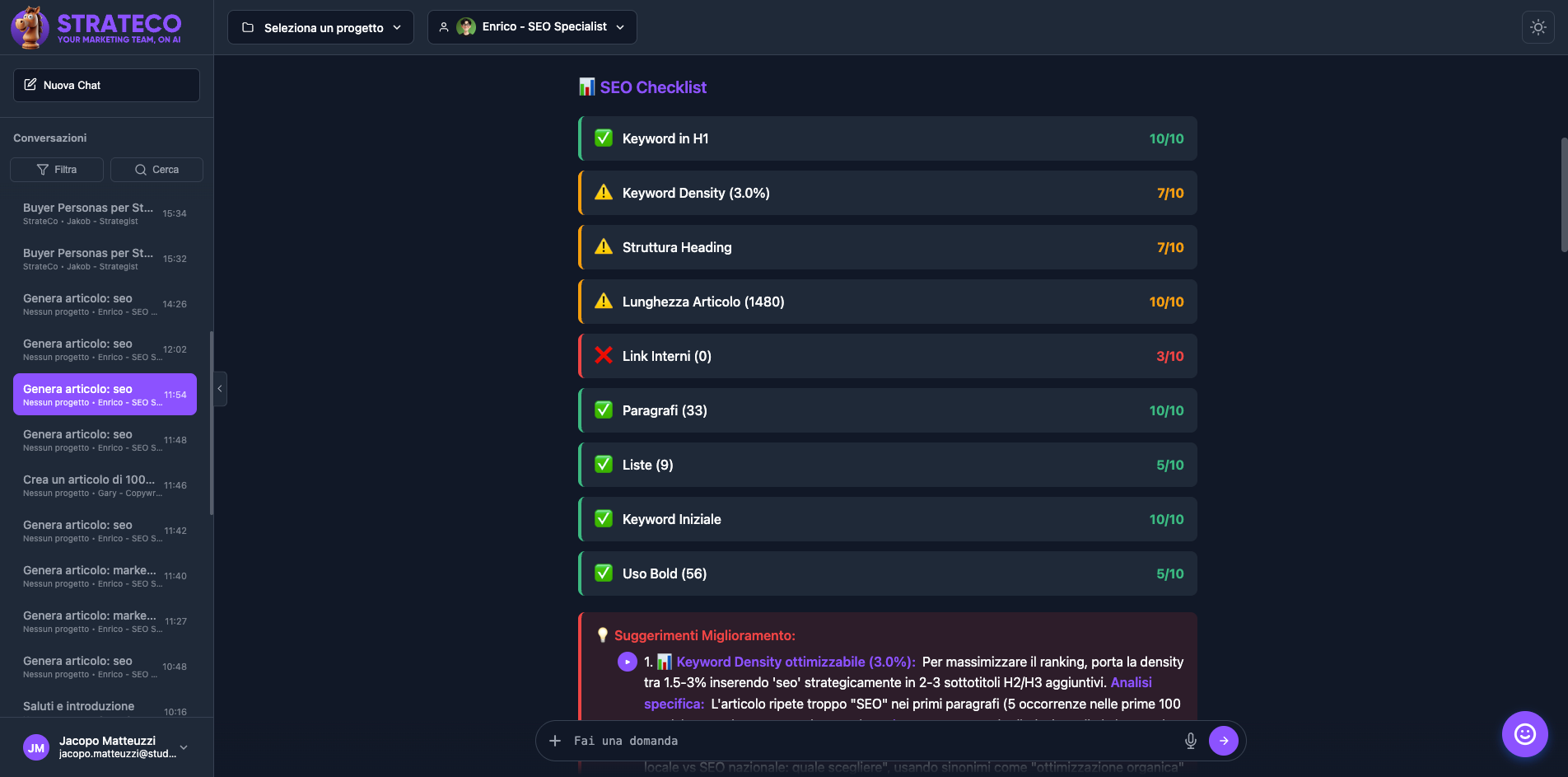
Each parameter shows a green, yellow, or red status with specific suggestions for improvement. From here, you can edit the article in the integrated editor, export it to HTML, or copy it directly.
What really changes in your routine
The issue is not replacing the marketer with a machine. The issue is eliminating the hours of mechanical work that precede the creative part: research, analysis, structure building.
Those who previously dedicated half a day to a pillar article can now generate the complete first draft in less than two minutes, concentrate their time on review and personalization, produce more quality content more frequently, and most importantly, base every article on real data instead of intuition.
For those managing a team of content creators, the difference is even clearer: the process becomes standardized, every article starts with a solid SEO foundation, and the freed-up time returns to strategy.
Where to start
If you produce content and want to stop having to choose between quality and speed, Enrico is ready to generate your first pillar article. You just need a keyword and a few seconds.
Register on strateco.ai, select Enrico from the dashboard, and ask him to create an article on the keyword that interests you most. You'll see the difference from the very first draft!